“Strange Fire”
Fire, Discernment, and the Collapse of Distinction
By: Dana Tibbitts
Date: June 2026
Source: https://www.nwasolution.org
All is not well with fire in America. Not the fire that has always existed — the lightning strike on a dry ridge, the slow ground fire that clears understory, opens cones, and moves the way fire has always moved through a living landscape. That fire belongs here. What is wrong is something harder to name, and that is part of the problem.
Fire is growing — not just in acres, but in behavior. In heat, in speed, in the way it moves through terrain and devours what it was never meant to consume. The story we keep being told—and telling ourselves—is both true and false. Fire season. Drought. Climate. Fuel loads. True as far as it goes, however, none of this fully accounts for what experienced firefighters, foresters, ranchers, regular Americans and long-time stewards of land are actually seeing on the ground.
Something else is happening. The question is whether we still have the capacity to see it clearly enough to say so.
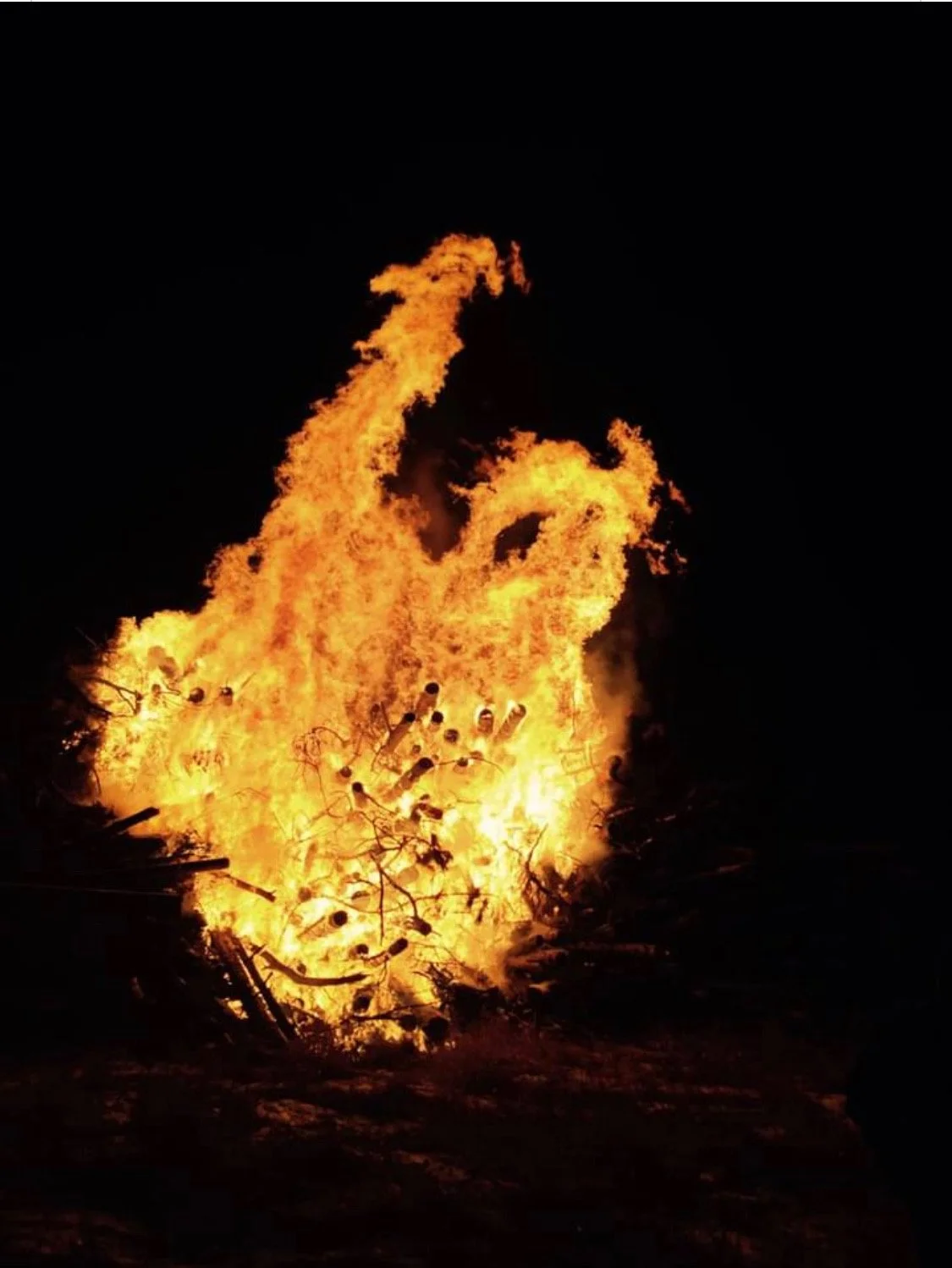
Logging slash machine-piled and burned by PFMc Wildfire Pros near Custer, South Dakota, winter 2015. Photo by Frank Carroll.
“STRANGE FIRE” & THE ANCIENT WARNING
In the book of Leviticus, two priests named Nadab and Abihu bring what the text calls "strange fire" into the sanctuary — fire unauthorized, severed from its rightful source—carried into sacred space where it has no business. They die for it. The consequence is immediate and severe. And what follows in the text matters: God speaks directly to his people about the need to distinguish between the holy and the profane, the clean and the unclean.
The warning about strange fire is inseparable from the loss of discernment that made it possible in the first place.
The Hebrew behind the phrase carries the sense of something foreign, forbidden, altered from its rightful origin, and improperly brought near to what is sacred. This is not a warning about fire's existence — fire already belonged at the altar. Fire warmed, illuminated, refined, and purified. Throughout Scripture it represents presence, revelation, and life itself. The danger was never the fire. The danger was fire severed from its source and invoked where God had forbidden it to go. The sacred does not host the profane without terrible consequence
This ancient framework reaches well beyond its religious context to the unflinching requirement for true discernment. Human beings are universally responsible for distinguishing between what is authentic and what is counterfeit, what belongs to the natural order, and what has been manipulated or profaned. The biblical word for profanation describes the corruption of something originally designed to sustain life, turned against its own purpose to serve another altar. And here is the tragedy: in the face of the profane, nobody notices.
BLURRING THE FIRE LINES
Modern society speaks of wildfire as though it belongs to a single category — natural, inevitable, even beneficial. And some fire is exactly that. Fire has always been part of the created order. But anyone who has spent meaningful time around forests, prescribed burns, indigenous fire stewardship, or historical fire ecology understands intuitively that not all fire behaves the same way or produces the same results.
Today, many fires burn through landscapes saturated with synthetic materials, utility infrastructure, plastics, treated lumber, lithium storage systems, transportation corridors, and expanding urban-wildland interfaces. Ignition itself may arise not from lightning or traditional fire ecology, but from technologically mediated systems: electrical failures, industrial accidents, equipment sparks, infrastructure collapse, prescribed burn escape, intentional ignition, or drone-based technologies increasingly used to monitor, manage, and direct fire behavior across the landscape.
Firefighters, land management professionals, and rural communities are encountering fires whose speed, intensity, thermal behavior, and destructive consequences appear radically disproportionate to historical norms — fires moving through altered environments containing synthetic compounds, modern construction materials, and technological systems capable of intensifying combustion far beyond what forest fuels alone would produce.
A fire burning through a lightning-struck wilderness watershed is not the same phenomenon as a fire intensified by technologically mediated ignition or human-engineered conditions. Yet modern public language collapses all of these into a single undifferentiated category: it's just fire season.
The collapse of distinction in humanity is the most dangerous degradation of all.
WHEN FIRE BECOMES INSTITUTIONAL
There is a deeper layer still, and it is here that the ancient warning about strange fire lands with the most force.
Across much of the American West, large fires are now planned, managed, and expanded within pre-drawn operational boundaries called PODs — Potential Operational Delineations. These are not maps of what the land does. They are maps of what agencies determine to be the highest and best use of taxpayer funds. They exist independent of ecological conditions, fire behavior, or the welfare of the communities that lie within or adjacent to them. They are institutional frameworks imposed on sacred terrain — and within them, fire is no longer primarily a natural force to be stewarded. It becomes a managed event, shaped by agency priorities and resource allocation.
Within this framework, there is no room for the sacred. Fire as creation's own agent of renewal — moving according to the rhythms of landscape, season, and ecological need — has no place in a system of pre-drawn burn perimeters and managed ignitions. That is not stewardship. By the oldest definition available to us, it is profanation: the unauthorized invasion of sacred terrain by fire that serves a different master entirely.
WHO PAYS. WHO PROFITS.
Strange fire, the ancient text made clear, is always costly. Nadab and Abihu paid with their lives. The profanation was not abstract — it had immediate, devastating consequences for real people. The same is true today, though the distribution of cost and consequence has been inverted in a way that should trouble anyone paying attention.
The cost of large fire operations in the American West is staggering — hundreds of millions, often billions of dollars per fire season, drawn from federal appropriations and ultimately from the taxpayers who live with the consequences of these fires over years and decades. The agencies managing fire receive massive and repeated reimbursements. Personnel costs, equipment costs, air support, logistics, overhead — all of it flows back through a funding system that is, at its structural core, tied to acres burned.
The more acres that burn, the greater the compensation. And that is not an accident of policy. It is the policy. Agency budgets, personnel justifications, and multi-year funding streams are built on the scale of fire activity. Larger fires generate not only primary suppression reimbursements but secondary and tertiary contracts for rehabilitation and restoration work that follows — work that is funded, repeated, and expanded, but that almost never produces a thriving, resilient forest. What it reliably produces is another budget cycle.
And then there are the firefighters. While much of the operational architecture of “wildfire” has shifted into highly technological systems operating out of sight and out of mind from the public sphere, the visible public narrative continues to center on firefighters, putting them up front in every fire story without providing the personal and institutional infrastructure needed to sustain them year-round.
Now consider who bears the actual cost of sustaining this wildfire industrial complex and paying the price of these fires, over decades. The family that loses its home receives no compensation. The rancher who forfeits grazing land, fencing, and decades of watershed stewardship gets nothing from the federal reimbursement system. The small community that loses its economic base, tax revenue, school enrollment, and every other index of health— none of this registers in the funding calculus. The people who suffer the most enduring consequences of large fire are the same people who fund the system through their taxes and receive nothing back from it when the system fails them.
That inversion — agencies compensated, communities abandoned – is not a bureaucratic oversight. It is the logical outcome of a system in which the incentive to burn has never been structurally restrained. No one designed it to be cruel. But the architecture is what it is, and that architecture currently rewards what it ought to prevent.
THE QUESTION THAT DEMANDS AN ANSWER
This warning is not ancient history. It is a description of the present moment.
In the ancient order of sacred responsibility, the gravest charges leveled at the priests is that they put no difference between the sacred and the profane — and the consequence was decline, not only in the land but in the people themselves, who gradually lost the capacity to distinguish between good and evil, clean and unclean, natural and manipulated. They could no longer protect what mattered because they could no longer see what was happening.
The ancient world called it a failure of priesthood. We might call it a failure of active management of our natural resources — the willful neglect of the highest order of service: to protect what is sacred and reject what is profane. The name may change. The condition has not.
Fire has always existed. Lightning has always struck. Forests have always burned and renewed themselves according to rhythms older than any agency, any funding cycle, any operational delineation. That fire is sacred. It belongs to the created order and serves it.
What is happening now is something different — fire shaped by institutional incentive, managed within pre-drawn boundaries that serve budget cycles rather than ecosystems, reimbursed by the acre at the expense of the very communities it destroys. Those who understand this best are often the ones closest to the land: the firefighters who recognize behavior that doesn't fit the official narrative, the foresters who watch restoration contracts awarded for forests that never recover, the ranchers and families who rebuild without compensation while the agencies that managed the fire destruction are made whole.
As long as acres burned remains the basis for agency compensation, the system will always find a reason to burn more of them.
Fire as a funding system is inherently profane.