Forest Fire Is Idaho's Largest Uncontrolled Tax
By: Jen Hamaker
Date: June 19, 2026 speech at annual Idaho Republican Party conference in Meridian, Idaho.
Source: Powerpoint Presentation .pdf
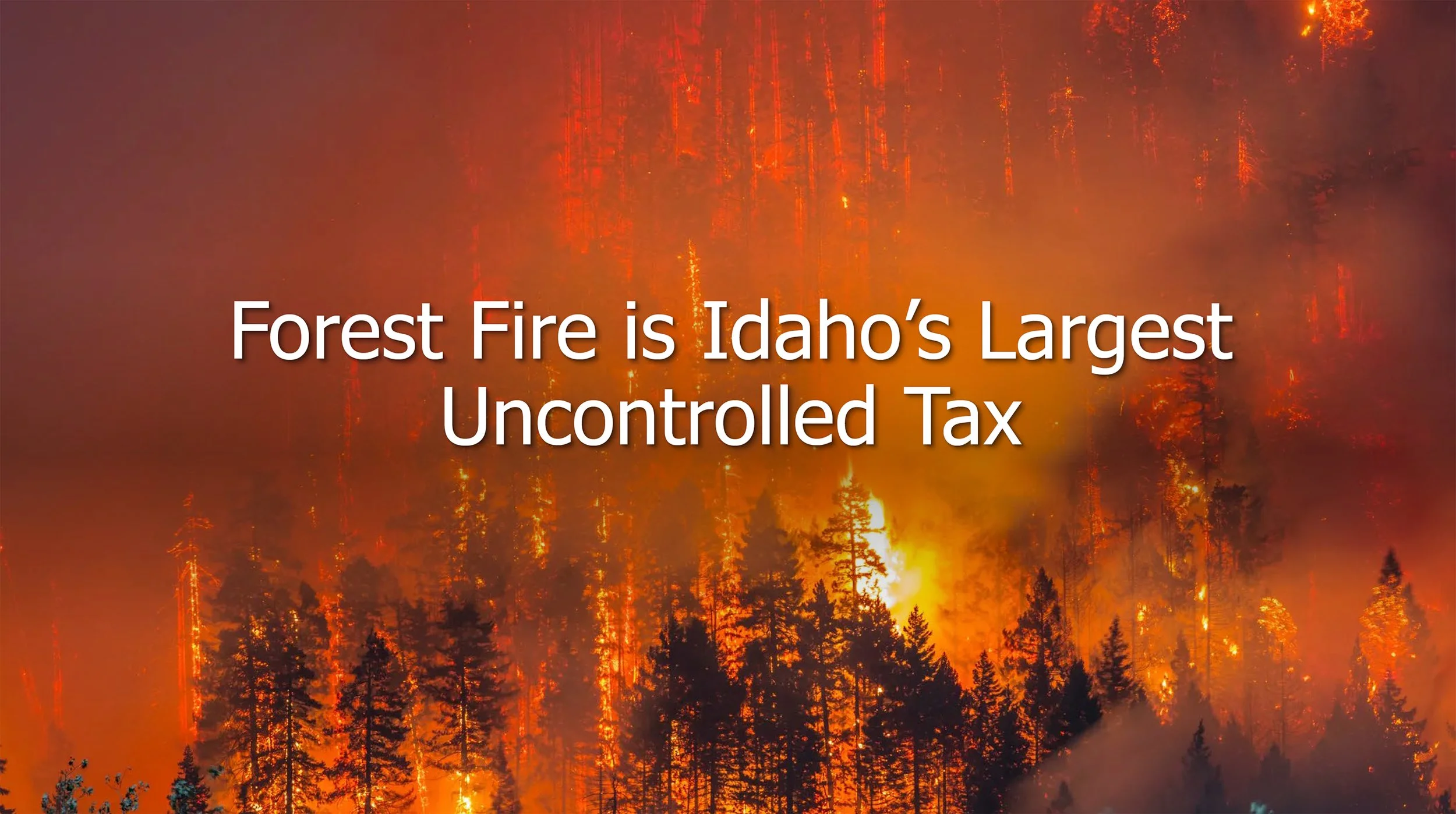
Most taxes arrive in the form of a bill.
Forest fire does not.
Forest fire affects Idahoans through suppression costs, emergency appropriations, infrastructure damage, increased insurance premiums, public health impacts, degraded watersheds, lost wildlife habitat, lost timber value, and reduced economic opportunities. The costs continue long after the flames are extinguished.
Most taxpayer dollars are debated, prioritized, and appropriated through the legislative process. Elected officials determine how much money will be spent and where it will go.
Forest fire doesn't ask permission.
It doesn't wait for a vote.
It doesn't care what was budgeted.
Every year, taxpayers effectively write a blank check to forest fire, paying whatever cost the fire season demands.
For many Idahoans, these costs are largely invisible. They appear in higher taxes, increased insurance rates, public expenditures, utility costs, restoration projects, and lost economic activity throughout rural communities.
On average, Idaho spends approximately $50 million annually fighting forest fire. During severe fire seasons, those costs can increase dramatically. Yet suppression costs represent only a fraction of the total economic impact.
The true cost of forest fire extends beyond the fire line.
When forests burn, Idaho loses more than trees.
We lose future timber revenue.
We lose future jobs.
We lose future school funding opportunities.
We lose wildlife habitat.
We lose watershed function and water quality.
We lose recreational opportunities.
We lose infrastructure.
And increasingly, we lose opportunities for future generations.
This is why forest fire can be viewed as Idaho's largest uncontrolled tax.
Unlike traditional taxes, forest fire destroys an asset while simultaneously generating costs.
Throughout this document, three themes will emerge:
Forest fire is Idaho's largest uncontrolled tax.
Forests are connected to everything.
We do not inherit our forests from our parents. We borrow them from our children.
Understanding these connections is essential to understanding the
My Connection to Forests
My name is Jen Hamaker. I live in Council, Idaho, west of McCall. I am the President of Oregon Natural Resource Industries (ONRI), an Idaho school board trustee, a wife, a mother, and someone who cares deeply about forests, rural communities, and the future of the places we call home.
My connection to forests is both professional and personal.
I am the granddaughter of Aaron Jones, who founded Seneca Sawmill in Eugene, Oregon in 1952. You could say I have sawdust running through my veins.
My grandfather never planned on becoming a sawmill owner. As a young boy in Texas, he experienced hardship that most people will never know. After spending part of his childhood in an orphanage, he was eventually sent to live with relatives on the Oregon Coast.
There, for the first time, he encountered the forests of the Pacific Northwest.
He fell in love with them.
He also fell in love with my grandmother, Deanee Bowman, whose family operated a small lumber business serving local residents. Through hard work, determination, and an endless curiosity about the forest products industry, my grandfather built what would eventually become Seneca Sawmill.
After World War II, America faced two significant challenges: providing jobs for returning veterans and building homes for a growing nation. Forests helped meet both needs. Timber created family-wage jobs, supplied raw materials for housing, and supported rural communities throughout the West.
My grandfather recognized that opportunity.
Over time, Seneca grew into one of the most innovative sawmill operations in the world, developing technologies that transformed how lumber was manufactured and utilized.
But what I remember most is not the mill itself.
I remember what it represented.
It represented jobs.
It represented families.
It represented communities.
It represented the belief that forests, when responsibly managed, could provide opportunities for generations.
Throughout his life, my grandfather viewed forests as more than a source of wood products. He viewed them as a renewable resource that, when cared for properly, could support people, wildlife, clean water, healthy communities, and future generations simultaneously.
That perspective shaped my own understanding of stewardship.
Today, when I advocate for healthy, resilient forests, I often think about the forests my grandfather loved and the communities they supported. I think about the responsibility we have to leave something of value for those who come after us.
The forests we enjoy today were planted, protected, and managed by people who understood they might never personally benefit from all of their efforts. They invested anyway.
That is stewardship.
And that is why this conversation matters.
Because we do not inherit our forests from the last generation.
We borrow them from the next.
The photograph accompanying this section is of my mother, my son Jake, and my niece and nephew, Ava and Parker, planting a tree together. The image serves as a reminder that stewardship is not ultimately about trees.
It is about future generations.
Understanding Forest Fire
Every forest fire requires three things:
Heat
Air (oxygen)
Fuel
This is known as the Fire Triangle.
Remove any one of these three components and a fire cannot sustain itself.
We cannot control the air.
We cannot control the heat.
But we can influence fuel.
Fuel includes dead trees, dense undergrowth, accumulated woody debris, overcrowded stands of timber, insect-killed trees, and other vegetation that allows fires to grow larger, hotter, and more destructive.
Managing fuel is one of the primary purposes of forest management.
Tools such as timber harvest, thinning, prescribed burning, fuel breaks, road systems, biomass utilization, and the removal of diseased or dead trees are all designed to reduce hazardous fuel loads and improve forest resilience.
The goal is not to eliminate fire.
Fire has always been a natural part of many forest ecosystems.
The goal is to reduce the intensity, severity, and cost of catastrophic forest fires while improving the overall health of the forest.
Healthy forests are generally more resilient to fire, drought, insects, and disease.
There are many examples of managed forests slowing the spread and intensity of forest fires. One of the most powerful occurred during Oregon's 2020 Labor Day fires. In numerous locations, managed forests, previously thinned stands, and recently harvested areas slowed fire progression and provided firefighters and residents valuable time to respond and evacuate.
While no treatment can stop every fire under extreme conditions, decades of research and real-world experience continue to demonstrate that actively managed forests are often more resilient than forests where fuels have accumulated unchecked.
The Fire Triangle reminds us of a simple reality: while we cannot control the weather, we can influence the fuel.
The question is not whether forests will be managed.
The question is whether they will be managed by a forester or by fire.
Forests: Assets or Liabilities?
The debate over forest management is often framed as a choice between harvesting trees and protecting forests.
In reality, the choice is much simpler.
Do we want our forests to remain assets, or do we allow them to become liabilities?
Idaho currently harvests approximately 200,000 acres of timber each year.
In contrast, Idaho burns approximately 600,000 acres annually.
In other words, we burn roughly three times more forestland than we actively manage through harvest.
That comparison is important because both harvest and forest fire remove trees from the landscape.
The difference is what happens afterward.
Forest management creates value.
Forest fire destroys value.
A managed forest supports jobs, schools, local businesses, manufacturing, wildlife habitat, recreation, clean water, and future forest growth.
Forest fire consumes those same resources while generating costs.
On average, Idaho spends approximately $50 million annually fighting forest fire. During severe fire seasons, costs can rise dramatically.
Those suppression costs are only the beginning.
Forest fire also destroys timber value, reduces future revenue, damages watersheds, impacts wildlife habitat, increases public costs, and removes economic opportunities that may take decades to recover.
Perhaps most importantly, forest fire destroys an asset that was generating future value.
A healthy forest is one of Idaho's most valuable renewable resources.
It grows.
It provides habitat.
It protects watersheds.
It stores carbon.
It supports recreation.
It creates jobs.
It funds schools.
It strengthens communities.
When that forest burns, taxpayers often pay twice.
First, to fight the fire.
Then again to recover from its impacts.
The forest will be managed one way or another.
The question is whether it will be managed intentionally by foresters or eventually by forest fire.
Understanding that distinction is important because the consequences extend far beyond the forest itself.
They reach directly into the communities that depend upon it.
Forests and Communities
The connection between forests and communities is often overlooked.
When most people hear the words "forest policy," they think about trees.
In rural Idaho, forest policy is also about jobs, schools, roads, emergency services, local businesses, and the long-term health of entire communities.
The photographs accompanying this section are of my hometown, Council, Idaho.
Like many rural communities throughout the West, Council was built around natural resources.
For generations, timber served as the economic engine that supported families, businesses, schools, and public services throughout Adams County.
The forests surrounding Council produced more than wood products.
They generated revenue.
They supported mills, logging contractors, truck drivers, equipment operators, mechanics, and countless small businesses.
They provided family-wage jobs and created economic activity that extended far beyond the forest itself.
Every log truck leaving the woods created a ripple effect throughout the community.
That economic activity helped support schools, roads, libraries, emergency services, law enforcement, local businesses, and many of the services residents rely upon today.
At one time, Adams County was among the most prosperous counties in Idaho.
Today, it is among the poorest.
Many factors contribute to economic change over time, but one lesson is difficult to ignore:
Communities are affected by the condition and productivity of the forests that surround them.
Beginning in the late 1980s and early 1990s, federal forest management policies changed significantly throughout much of the West. Federal timber harvest levels declined sharply, and millions of acres of federal forests experienced reduced active management.
Those decisions were made with specific goals in mind.
Today, more than forty years later, we are witnessing many of the outcomes.
We are witnessing denser forests.
We are witnessing drought.
We are witnessing larger fuel accumulations.
We are witnessing longer fire seasons.
We are witnessing larger and more costly forest fires.
We are witnessing increasing suppression costs.
And in many places, we are witnessing the continued decline of forest infrastructure and rural economies that once depended upon active forest management.
Policy matters.
The forests we see today are the result of decisions made decades ago.
Likewise, the forests our children inherit will be shaped by the decisions we make today.
Forests and communities are connected.
Healthy forests support healthy communities.
When forests lose their productivity and resilience, communities often lose opportunities as well.
Understanding that connection is essential to understanding why forest management matters.
Forests: Writing Checks or Sending Bills?
There are two paths for Idaho's forests.
One creates value.
One destroys it.
Every year, Idaho's forests write checks to our schools, communities, businesses, and workers.
Every year, forest fire sends bills to taxpayers.
The question is not whether forests will affect Idaho's economy.
The question is whether they will do so as an asset or a liability.
Forest fire is Idaho's largest uncontrolled tax.
Healthy forests are one of Idaho's greatest economic opportunities.
The economic contributions of Idaho's forests are substantial.
Each year, Idaho's forest products industry contributes approximately $2.9 billion to Idaho's economy.
The industry supports more than 31,000 jobs and generates more than $2.2 billion in labor income paid to Idaho workers and their families.
Idaho harvests approximately one billion board feet of timber annually.
To help visualize that number, one billion board feet of timber produces enough lumber, in the form of 2x4x8 studs, to circle the Earth approximately seventeen times.
That same volume of lumber is enough to build approximately 80,000 average 2,000-square-foot homes.
Every one million board feet harvested supports approximately 31 jobs throughout Idaho's economy.
Forests also play a direct role in funding public education.
Approximately $100 million is distributed annually from Idaho's Endowment Lands to schools and other beneficiaries.
Over the past decade, nearly $1 billion has been distributed through Idaho's endowment system, with public education serving as the largest beneficiary.
Healthy forests create value.
They generate revenue.
They create jobs.
They support schools.
They strengthen communities.
They provide opportunities for future generations.
Forest fire does the opposite.
In 2024 alone, Idaho spent approximately $66.6 million fighting forest fires.
Nearly one million acres burned across the state.
Using average timber volumes, that represents approximately four billion board feet of timber.
To put that into perspective, four billion board feet could produce enough lumber to build more than 300,000 average homes.
But the loss extends far beyond lumber.
When forests burn, we do not simply lose trees.
We lose future homes.
We lose future jobs.
We lose future school revenue.
We lose wildlife habitat.
We lose watershed function.
We lose clean air and clean water.
We lose economic opportunities that may take decades to recover.
A healthy forest is an asset on Idaho's balance sheet.
A forest fire is a liability.
Managed forests produce revenue.
Unmanaged forests produce expenses.
Both managed forests and forest fires create disturbance.
One is planned.
One is not.
One creates jobs, revenue, and future forest growth.
The other consumes taxpayer dollars, destroys value, damages infrastructure, and eliminates future opportunities.
The question is not whether our forests will experience disturbance.
The question is which disturbance we choose.
The forests we see today are the result of past stewardship—or the lack of it.
The forests our children inherit will reflect the choices we make today.
Forests Are Connected to Everything
By now, a common theme should be emerging.
Forests are not simply collections of trees.
They are connected to schools, jobs, communities, public safety, wildlife, clean water, recreation, housing, and Idaho's economy.
When most people hear the words forest policy, they think about trees.
In reality, forest policy is also about people.
It affects the families who live, work, hunt, fish, recreate, and build their lives in Idaho.
It affects the communities that depend upon healthy forests and the economic opportunities they provide.
Healthy forests create benefits that extend far beyond the forest itself.
They provide clean water.
They support wildlife habitat.
They generate renewable resources.
They create jobs.
They fund schools.
They strengthen communities.
When forests are healthy, Idaho benefits.
When forests become unhealthy, the consequences extend far beyond the tree line.
The good news is that we know how to grow healthy forests.
We know how to reduce forest fire risk.
We know how to improve wildlife habitat.
We know how to protect watersheds.
We know how to produce renewable resources while caring for the land.
The challenge is not a lack of knowledge.
The challenge is applying that knowledge consistently over time.
Because forests operate on decades, not election cycles.
The forests we see today are the result of decisions made decades ago.
And the forests our children inherit will be shaped by the decisions we make today.
Idaho's Constitutional Connection to Forests
Many Idahoans are unaware that forests are woven directly into Idaho's constitutional framework.
When Idaho became a state in 1890, Congress granted approximately 3.6 million acres of land to support public institutions. Today, approximately 2.4 million acres remain as Idaho Endowment Trust Lands, including nearly one million acres of timberland.
Those lands were not given to Idaho as parks or preserves.
They were granted as working assets intended to provide long-term financial support for public beneficiaries.
Article IX, Section 8 of the Idaho Constitution requires these lands to be managed to secure the maximum long-term financial return for designated beneficiaries.
The largest beneficiary is Idaho's public school system.
For more than a century, Idaho's Endowment Lands have generated revenue for public schools, universities, veterans homes, hospitals, and other public institutions.
Today, Idaho's endowment timberlands distribute approximately $100 million annually to beneficiaries, with public education receiving the largest share.
Over the last decade, nearly $1 billion has been distributed through Idaho's endowment system.
That connection between forests and education is not accidental.
It is constitutional.
What is perhaps most remarkable is that Idaho's founders understood something that remains true today:
Forests must be managed for the long term.
Trees grow over decades.
Forest investments often take generations to realize their full value.
The people who drafted Idaho's Constitution understood that responsible stewardship and long-term economic stability go hand in hand.
They created a system designed not simply to generate revenue for one generation, but to provide benefits for future generations as well.
In many ways, Idaho's Endowment Lands represent stewardship in action.
Trees planted decades ago continue to support students today.
The management decisions made today will influence the opportunities available to future generations of Idahoans.
That principle should sound familiar.
The forests we enjoy today are the result of decisions made by those who came before us.
And the forests our children inherit will be shaped by the decisions we make today.
The connection between forests, schools, communities, and future generations is not accidental.
It is woven into Idaho's history.
It is woven into Idaho's Constitution.
And it remains one of the clearest examples of why stewardship matters.
More than a century later, they continue to fulfill that purpose.
They were building something intended to last.
A Log Truck Carries More Than Wood
Most people don't think much about a log truck.
They see it on the highway and wait for an opportunity to pass.
What many people don't realize is that a log truck represents far more than timber.
A typical Idaho log truck carries approximately 4,500 board feet of timber and about $2,500 worth of raw wood value.
That may not sound like much until you consider what that timber becomes.
Three log trucks can provide enough lumber to build an average 2,000-square-foot home.
Four log trucks represent approximately what the State of Idaho spends to educate one student for a single year.
Fifty-two log trucks represent the value of educating a student from kindergarten through high school graduation.
Suddenly, a log truck becomes much more than a load of timber.
It becomes a way to visualize the connection between Idaho's forests, schools, communities, and future generations.
Those same log trucks support truck drivers, loggers, mill workers, equipment operators, mechanics, foresters, engineers, contractors, and countless small businesses throughout Idaho.
They generate economic activity that supports local communities and helps fund the schools, roads, and public services Idaho families depend upon.
A log truck does not simply carry wood.
It carries jobs.
It carries paychecks.
It carries opportunity.
Forestry statistics are often measured in acres, board feet, and millions of dollars. Those numbers can feel abstract.
A log truck helps make forestry tangible.
It reminds us that forests are not simply part of Idaho's landscape.
They are part of Idaho's economy, its communities, and its future.
Stewardship
My grandfather, Aaron Jones, considered himself a true environmentalist.
Not because he believed forests should be left alone.
But because he loved them.
He spent his life in them.
He understood them.
He depended on them.
And he believed they were worth caring for.
To him, stewardship was not a slogan.
It was a responsibility.
Stewardship is action.
Stewardship is planning.
Stewardship is investing today for benefits you may never personally see.
Stewardship is planting a tree whose shade your grandchildren will enjoy.
Stewardship is reducing fuels before the fire starts.
Stewardship is maintaining roads before an emergency.
Stewardship is creating healthier forests, cleaner water, better wildlife habitat, stronger communities, and opportunities for future generations.
Stewardship means recognizing that forests are not simply something we own.
They are something we are entrusted with.
A healthy forest is a treasure.
A managed forest is a treasure box.
Stewardship is the key that unlocks it.
The forests we enjoy today were planted, protected, and managed by people who would never live long enough to experience all of the benefits.
They were thinking beyond themselves.
The question before us is whether we are willing to do the same.
Because we do not inherit our forests from the last generation.
We borrow them from the next.
One of the most overlooked aspects of stewardship is reforestation.
Forest fire does not require reforestation.
Timber harvest does.
Whether on private land, state land, or through salvage operations, harvest triggers legal requirements to regenerate the forest and establish the next generation of trees.
Even more importantly, reforestation is paid for by the landowner, mill, or timber operator—not the taxpayer.
The public receives the benefits while the cost of reforestation is borne by those who manage and utilize the resource.
In Idaho, approximately three trees are replanted for every tree harvested.
Seedlings are typically planted at approximately two years of age, giving them the best opportunity to survive and establish healthy future forests.
That is stewardship.
Not simply using a resource.
But ensuring that something of value remains for those who come after us.
The forests we enjoy today exist because previous generations invested in a future they would never see.
Our responsibility is to do the same.
Infrastructure Follows Certainty
Healthy forests depend on consistent management.
Consistent management depends on infrastructure.
And infrastructure depends on certainty.
Healthy forests depend on something most people have never connected to forest health:
Infrastructure.
Loggers.
Truck drivers.
Foresters.
Sawmills.
Roads.
Equipment.
Biomass facilities.
The skilled workforce and businesses that make active forest management possible.
When people think about forest health, they often focus on trees.
What they don't always see is the infrastructure required to care for those trees.
Forest management does not happen by accident.
It requires people, equipment, markets, transportation systems, manufacturing facilities, and decades of investment.
The most valuable thing government can provide is not a subsidy.
It is certainty.
Forests grow over generations, yet many public policies operate on annual budgets and political cycles.
A forest cannot be managed on a two-year election cycle.
It requires decades of planning, investment, and commitment.
Healthy forests depend on consistent management.
Consistent management depends on infrastructure.
And infrastructure depends on certainty.
No company invests millions of dollars in a sawmill if it does not know whether timber will be available ten years from now.
A logging contractor does not purchase a million dollars of equipment because of one timber sale.
A truck driver does not build a business around a short-term opportunity.
A bank does not finance expansion based on one good year.
These investments occur when people believe the work will still be there ten, twenty, and thirty years into the future.
That confidence creates infrastructure.
And infrastructure creates the capacity to steward our forests.
Right now, Idaho still has much of that capacity.
We still have mills.
We still have loggers.
We still have truckers.
We still have foresters.
We still have family-owned forest businesses.
But infrastructure is far easier to lose than it is to rebuild.
Over the past several decades, communities throughout the West have witnessed the closure of mills, the loss of logging contractors, and the decline of forest management capacity. Once that infrastructure disappears, it rarely returns.
A sawmill is not built overnight.
A skilled logging workforce is not trained overnight.
A trucking fleet is not assembled overnight.
Forest management capacity is built over decades and lost surprisingly quickly.
The consequences extend far beyond the economy.
Without infrastructure, forests become more difficult and more expensive to manage.
Without mills, there are fewer markets for low-value material removed during thinning projects.
Without loggers and truckers, fewer treatments occur on the landscape.
Without capacity, stewardship becomes increasingly difficult.
That is why certainty matters.
The infrastructure we have today was built by generations of people who believed there would be a future worth investing in.
The forests our children inherit will depend upon whether that confidence remains.
If we want healthy forests, clean water, resilient wildlife habitat, family-wage jobs, and strong rural communities, we must maintain the infrastructure that makes stewardship possible.
Because stewardship is not simply a forestry issue.
It is an infrastructure issue.
And infrastructure follows certainty.
Idaho's Window of Opportunity
For much of this document, we have focused on challenges.
Forest fire.
Lost infrastructure.
Declining forest management capacity.
The consequences of decisions made decades ago.
But stewardship is not simply about understanding problems.
It is about recognizing opportunities.
And Idaho has one right now.
Idaho has the forests.
Idaho has the workforce.
Idaho has the expertise.
Idaho has the infrastructure.
And for perhaps the first time in decades, Idaho has a federal government moving in a direction more aligned with active forest management and forest science.
Regardless of politics, something important is happening.
The national conversation is shifting.
Federal leaders are increasingly acknowledging that we cannot litigate, regulate, and delay our way to healthy forests.
The focus is moving toward active management, hazardous fuels reduction, forest restoration, wildfire prevention, stewardship, and increasing the pace and scale of projects on the ground.
The goal is simple:
More stewardship.
More management.
More healthy forests.
For Idaho, that creates a window of opportunity.
Recently, U.S. Forest Service Chief Tom Schultz made an observation that should capture everyone's attention.
The problem is not a shortage of trees.
The problem is a shortage of markets.
Think about that.
For years Americans have been told we are running out of timber.
Yet forests continue to grow denser.
Fuel accumulations continue to increase.
Wildfire risk continues to rise.
And the United States continues to import billions of dollars of wood products from other countries each year.
According to Chief Schultz, National Forests once produced approximately 12 billion board feet of timber annually.
Today, that number is only a fraction of what it once was.
The challenge is not whether the resource exists.
The challenge is whether we have the capacity, infrastructure, markets, and policy certainty necessary to put that resource to work.