A Fire-Worthy World
By: Frank Carroll
Date: February 2026
Source: www.WildfirePros.com
Wildfire season in the American West is no longer a “season” with a sigh of relief at the end. Now, It’s your grandpa with COPD: chronic, systemic, and often fatal. Smoke and evacuation alerts have become as familiar as school calendars and holiday plans. We routinely watch 100,000‑acre fires charge across dry landscapes, threatening communities and straining the people and systems asked to fight them.
Yet for all our experience, our spending priorities are failing us. We behave—politically and financially—as if the main event is putting fires out, not preventing them from turning into monsters in the first place.
Look at the numbers.
A large Western wildfire that burns 100,000 acres in peak fire season typically costs tens to hundreds of millions of dollars to fight. Suppression costs alone—crews, aircraft, engines, dozers, overhead, logistics—often fall in the range of $500–$1,500 per acre on big Western fires. A 2013 study of 1,500-acre fires showed costs of $8,000 per acre across the West. Many high‑profile fires punch much higher when they threaten communities, infrastructure, or critical watersheds.
Do the basic math. At $500 per acre, a 100,000‑acre wildfire costs about $50 million to suppress. At $1,000 per acre, it’s $100 million. At $1,500 per acre, it’s $150 million. In smaller fires, $8-10,000 per acre is common. That is an astonishing amount of public money to spend on what is, at its core, emergency damage control.
And that’s before we talk about what doesn’t show up in the incident ledger: burned homes and businesses, wrecked power and transportation infrastructure, hospital visits from smoke, months of lost tourism or timber revenue, post‑fire flooding and debris flows, restoration bills that drag on for years, and the quiet trauma that lingers in families who have lost their homes, their health, or their sense of safety. If we counted those, the “cost” of a single 100,000‑acre megafire can easily run into hundreds of millions or even billions of dollars.
Now compare that with what it costs to reduce the risk ahead of time.
Mechanical fuel treatments—mowing, mastication, thinning, and related work often paired with prescribed fire—currently run roughly $600–$1,500 per acre, with highs at $7,000 per acre in many Western forests and wildland‑urban interface areas, depending on terrain, access, and project complexity. Fuels mitigation requires skilled crews, equipment, environmental analysis, and careful planning with local communities and tribes.
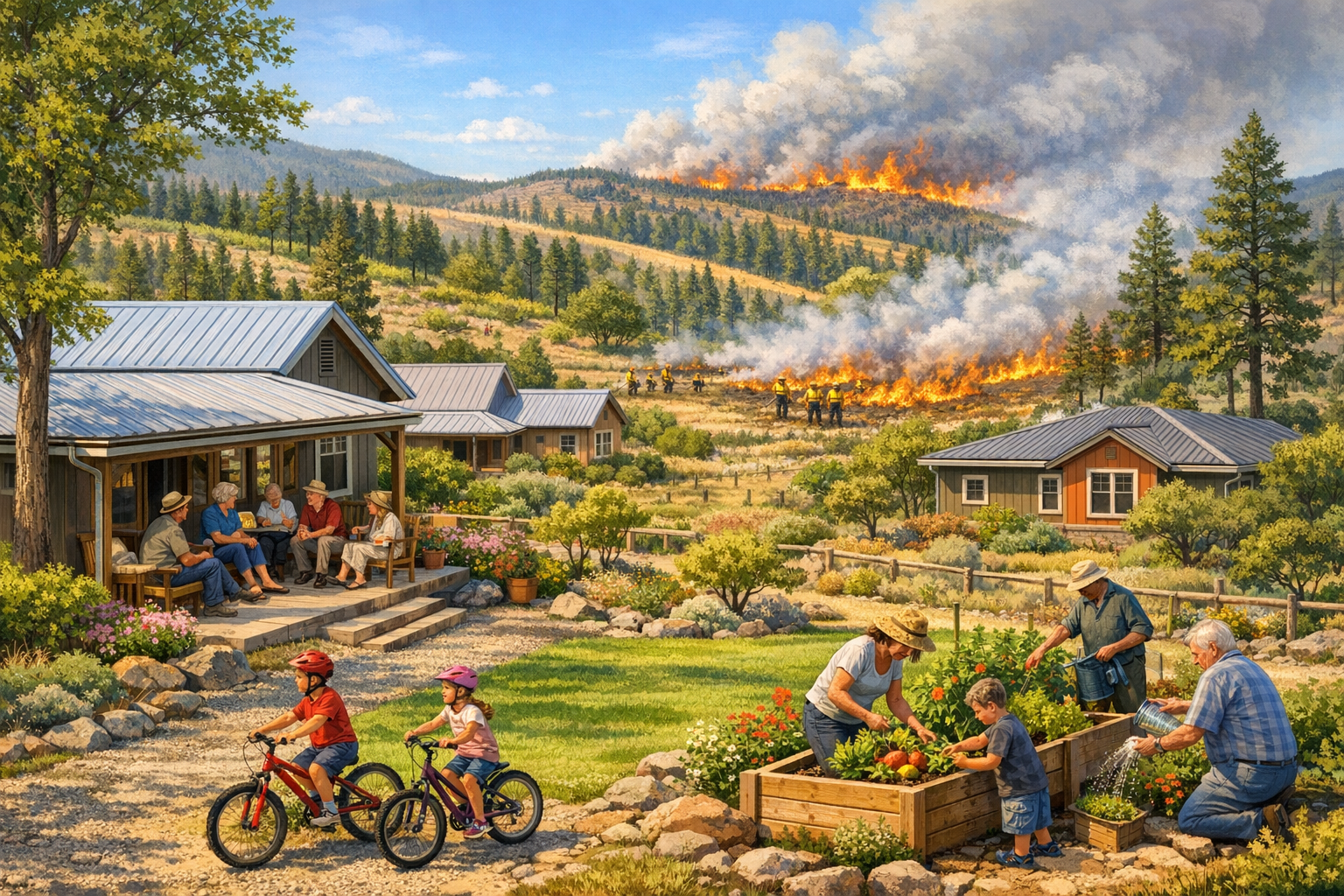
But the scale of what we get for that investment is dramatically different.
Suppose we invest $600 per acre in mechanical treatments and associated work. For the same $60 million we can easily spend in a single season on a 100,000‑acre wildfire, we could treat 100,000 acres of high‑risk forest and rangeland. At $1,000 per acre, $100 million treats 100,000 acres. Even at the high end, $1,500 per acre, the $150 million it might cost to suppress a large, complex fire could fund treatments on 100,000 of the highest‑priority acres where communities, infrastructure, and watersheds are most at risk. At $8,000 per acre, we could turn at-risk rural communities into manicured alpine villages.
There is no perfect one‑to‑one comparison. Suppression costs are emergency expenditures; treatment costs are planned investments. Treatment doesn’t guarantee that no fires will occur, nor that the treated acres will never burn. But the real question is not whether we can stop fire. We cannot. The question is whether we want those inevitable fires to rip through overloaded fuels in explosive fashion—or move through fire-worthy landscapes that will burn and live to burn again. In a paradox of forests and fire, the more a forest experiences periodic, low intensity, under burns, the more fire-hardened and fire-worthy it becomes.
Properly designed fuel treatments can:
- Slow fire spread and reduce flame lengths, giving firefighters safer, more effective options;
- Change crown fires into surface fires, often sparing mature trees;
- Protect key access routes and safety zones for both firefighters and evacuees;
- Create strategic “speed bumps” that make containment lines more likely to hold;
- Reduce the chances that a lightning strike or roadside spark becomes the next town‑destroying headline.
While fuel treatments don’t “stop” fire, they make fire more manageable, less catastrophic, and easier and safer to fight and survive.
Money-wise, choosing not to treat high‑risk landscapes is a bet that we will either get lucky or that we will be able to outspend the flames later. Recent years should have disabused us of both illusions. We are not getting lucky, and we are already spending staggering amounts trying to hold a line that will not hold.
From a moral perspective, the imbalance is even harder to justify. We routinely mobilize fleets of aircraft, thousands of firefighters, and massive support systems into dangerous conditions when the fire is already running. We owe our firefighters—and the communities behind them—an equally serious investment before the fire bell rings. Investing in mechanical treatment and prescribed fire is about firefighter and community safety, and living with fire.
And we shouldn’t pretend that the “do nothing” option is environmentally neutral. Unmanaged fuel accumulation is a recipe for precisely the kind of high‑severity, stand‑replacing fires that alter soils, obliterate seed sources, and set the stage for invasive species. Thoughtful mechanical treatments, often combined with cultural burning and prescribed fire, are a way to re‑design our landscapes to live with fire, not to pretend we can banish it.
Our political world tends to reward the dramatic and immediate: airtankers painting the sky red, heroic saves on the six o’clock news. Fuel breaks and thinning projects don’t make for spectacular footage. They are quiet successes, measured in disasters that never quite happen.
That is exactly the point.
We can keep pretending that the only time to spend serious money on wildfire is when the flames are already at the back fence—when overtime is maxed out, aircraft day rates are running, and communities are packing up their lives in plastic bins. Or we can start shifting real resources—billions, not millions—into proactive, science‑based, community‑driven fuel mitigation at $600–$1,500, even $8,000 per acre, reshaping the very conditions that make megafires inevitable.
In the end, it’s a simple choice.
We can continue to spend vast sums to herd 100,000‑acre infernos through choked forests and parched grasslands, then kick through the ashes and ruins of once‑living forests and vibrant rural communities—counting our losses, filing our insurance claims, and promising to “build back better” from a disaster we saw coming.
Or we can decide, together, to invest in the landscapes and communities we love—before they burn—accepting fire as a natural force while refusing to accept catastrophic results. We can thin, treat, and burn under our own terms, and design communities that are ready for the fires that will come.
We can kick through the ashes and ruins of once living forests and vibrant rural communities, or we can live joyfully in a fire‑worthy world.