Prescribed Fire Planning
By: Royal Burnett
Date: June 13, 2026
Source: NWAsolution.org
I’ll try to explain some of the common terms used in regard to fire use in the wildlands.
Prescribed fire...A prescribed fire (RxFire) is a fire that is deliberately set under predetermined weather and fuel conditions to achieve a desired result.
1. A prescribed fire should have defined control lines. These could be natural fire breaks like a river or rock outcroppings or preconstructed control lines. I personally discourage the use of natural barriers since they are hard to access and patrol.
2. A prescribed fire should have a defined start and stop time...an example would be “We will burn 20 acres of pine understory in Section 32… start time will be 1000 hours June 13 and firing will be complete at 1500 hours. “
3. A prescribed fire is set with stated objectives. “The purpose of this burn is to reduce the ground litter and kill unwanted brush invading the stand”.
4. A prescribed fire should have predetermined firing and holding crews.
5. A Prescribed fire should have a written contingency plan...”One additional bulldozer and two engines will be stationed that Whitmore and Shingletown FFS ...response time 10 minutes. Secondary lines will be Ponderosa Way.”
6. A test burn should be conducted prior to any prescribed fire to see that the fire burns as predicted. If the inputs are wrong the prescription is wrong.
7. A prescribed fire should have stated follow up inspections to insure the goals were met. The plan should include post fire rehabilitation where needed.
A prescribed fire must have stated weather and fuel conditions… that is the prescription. In order to write the prescription, the author must know the desired results. For instance in the above mentioned understory burn we would probably want a desired flame length of no more than 2 feet… hot enough to kill young brush and burn pine needles but not so hot to allow the fire to damage the crown of the stand.
You could write any other considerations into a prescription … like wind direction… example: Wind should be from the South to avoid smoke pollination in nearby homes.
Our plan could consider a wildlife concern… burns should be done in February/March to avoid disturbing ground nesting bird populations of Mountain Quail and Turkey.
In order to predict he behavior of the fire, the author must know what FUEL MODEL replicates his burn. There are many fuel models… these are computer inputs that describe the size, arrangement and composition of wildland fuels. The FUEL Model is a critical input into the FIRE SPREAD MODEL that predicts the spread and intensity of the fire.
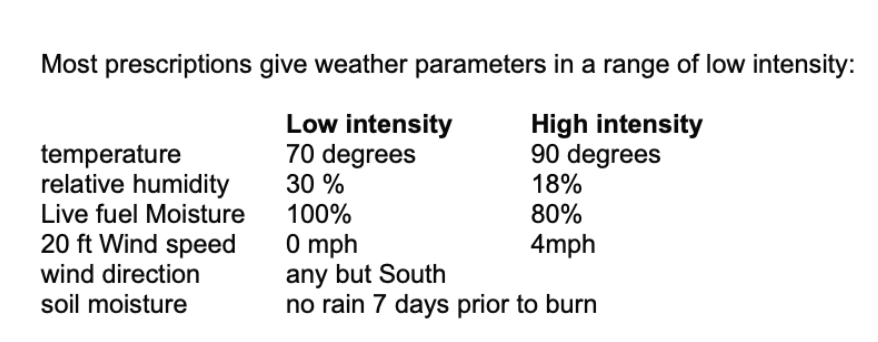
Using the Wildfire Pocket Analyst wildland fire calculator available in the App store…. I entered that we are using Fuel Model 2 ( grass and pine understory) and the result is a 2.2 flame length and a rate of spread of 3.2 chains/hour ( One chain equals 66 feet ) if we light our fire with all of the high intensity factors present. Scorch height is predicated 12.9 feet if all of the high intensity factors are present. Ignition probability is 90%… that means we’ll probably get spot fires, but with these conditions and slow rate of spread we should be able to catch them with holding crews.
If the fire was in Oak Savannah Grassland and the desire was to remove all one hour fuels and kill sprouting brush the Prescription would probably be hotter:
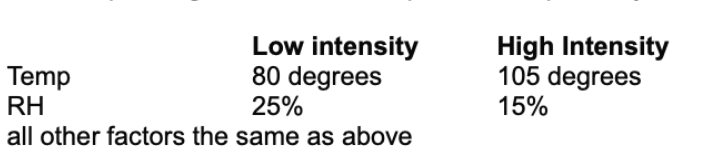
We can burn the lighter fuels on hotter days because they burn out faster and are not as receptive to spotting as some of the timber fuels… But the old rule of thumb says “It always burns twice as hot on the wrong side of the line.”
The WFA Pocket Guide uses the BEHAVE Fire Spread Model to predict fire behavior. It’s a good tool, but it does not replace good judgment or common sense. This tool will not make you a good firemen...but it will make a good fireman better.