Forest Restoration: Problems and Opportunities Revisited
By Bob Zybach
Date: March 20, 2019
Source: https://www.oregonfishandwildlifejournal.com
Publication .pdf
How actively managing our western forestlands on a landscape-scale can immediately create thousands of rural jobs, greatly reduce catastrophic wildfire risks and damages, return millions of dollars to our state and federal treasuries, increase native wildlife populations, fund our rural schools, roads, and libraries, and make our forests and grasslands safer and more beautiful than ever before. Seriously.
[This article is a slightly updated reprint of the first article I wrote for this magazine, in the Spring 2012 issue. Since then we have continued to witness catastrophic wildfires in northern California, Oregon, Idaho, and Washington that have burned millions of acres, killed millions of wildlife, grossly polluted the air in our major towns and cities for weeks on end, and killed dozens of people. All predictable, and all preventable if corrective actions – generating thousands of jobs and millions of dollars in profits and tax revenues – had been taken first. What was true seven years ago remains true today; and for tomorrow, too. BZ/20190320]
Western forestlands have never been in worse shape: millions of acres of dead and rotting trees; thousands of miles of abandoned and barely maintained roads; record setting wildfires becoming larger, deadlier, and more destructive by the year; hundreds of artificially impoverished rural communities; and endless litigation preventing the use of resources we need to sustain our lives and our economy.
There are a number of reasonable ways to resolve these problems; a long-term commitment to active forest restoration and management would seem to offer the most immediate benefits to both people and wildlife, and to be the most likely route to long-term economic sustainability as well.
What is forest restoration, why is it needed, and how is it done are the questions addressed in this article. Two examples of current forest restoration projects are profiled to help answer these questions, and to illustrate how these types of programs can be immediately implemented across the landscape to the benefit of neglected forests and depressed timber-dependent communities throughout the West.
What is Forest Restoration?
The process of forest restoration is focused on returning an area to one reflecting desired past conditions. It is critical to understand a) what conditions were actually like in the past, and b) which of those characteristics (if any) should be restored or preserved for the future.
For the past 10,000 years and longer, people living in Oregon have used and managed native plants and animals for their own purposes: principally for food; shelter; fuel; and fiber products, such as clothing, basketry, musical instruments, canoes, ropes, and weapons. Fire was used for a wide range of purposes: for cooking, heating, and lighting areas around homes and campgrounds; for rejuvenating berry patches and harvesting fields of grain; for hunting game by systematically setting vast tracts of land on fire.
Man is the only animal that can use fire, but he is not the only animal that benefits from it. The expert and judicious use of fire across the ancient landscapes of Oregon resulted in the stable patterns of forests, woodlands, vast prairies, wetland meadows, brakes, balds and berry patches encountered by Oregon Trail immigrants when they first arrived here in the 1840s and 1850s. The great numbers of elk, deer, songbirds, fish, squirrels, migratory fowl, and other animals that populated these environments were noted and documented by many of the new residents.
By that time, though, most of the Indian communities in this region had been decimated by plagues of deadly diseases introduced by Asian, African, European, and American explorers, hunters, and traders in earlier decades. The new arrivals, encountering a land nearly devoid of native people, assumed they were “settling” a “natural” landscape created by their God or by Nature, just for them. “Manifest Destiny.” That mistaken belief persists to this day in our popular books and films, in our scientific literature, and in our legal system, and is a key reason so many of our forests and grasslands are in such degraded conditions at this time.
Forest restoration, more than any other definition, means restoring people to the land; and restoring them in such a way that they feel safe, whether in the woods, along a river, or walking through a town. Restoring people to the land also supposes restoring fire to the land; fires set by people, not by lightning.
Upper South Umpqua Project: Considering Past Conditions is Step 1.
The map shown in this article represents a critical step in the forest restoration process – a determination and documentation of likely past conditions for areas being considered for restoration. This step is quite often ignored, or even unrecognized, invariably resulting in failed projects over time. Whenever we plan to restore something, it is important we understand the actual conditions – including presence and actions of people -- that existed in the past.
The Upper South Umpqua Headwaters Precontact Reference Conditions Study focused on characterizing a significant portion of the Umpqua National Forest in Douglas County, as it likely existed in 1825, prior to white contact. The study area is slightly more than 230,000 acres in size and extends from the crest of the Cascade Range at elevations greater than 6,000 feet, westward to the confluence of Jackson Creek with the South Umpqua River at approximately 1,100 feet elevation. The map shows the location and composition of forest type patterns and basic travel routes as they likely existed in the study area 200 years ago. Each of the subsequent four photographs documents a typical example of the four identified forest types, and illustrates potential forest management actions needed to restore and maintain desired future conditions.
One of the basic purposes of forest restoration is to reduce wildfire risk and damages. The method for achieving this in overstocked stands of conifers is to significantly reduce their biomass (“fuel load”) and open up the tree canopies (“thinning”) as they existed in earlier times, when catastrophic-scale crown fires were uncommon occurrences. On federal lands this is referred to as an “FRCC 1” condition.
The Upper South Umpqua Project was initiated by Douglas County Commissioner, Joe Laurance, to consider the possibility of restoring degraded local forestlands to this type of condition. On July 15, 2010, he testified to a Congressional subcommittee of The House Natural Resources Committee in Washington, DC:
“Fire Regime Condition Class (FRCC) 1 is similar to the forest which European explorers first found here. That forest had been modified by fire for more than six thousand years to provide the native inhabitants with what were then life’s necessities. These included abundant wild game from the most productive and diverse wildlife habitat ever known on this continent. Similarly, the regular burning of competing vegetation permitted propagation of nut bearing trees and other food producing plants. Additionally, the historic “Healthy Forest” promoted pristine rivers, streams, and lakes that provided an abundant harvest of fish and waterfowl. Within FRCC 1 the risk of losing key ecosystem components to fire is low, while vegetation species composition, structure, and pattern are intact and functioning within the natural historic range.”
Research methods used to determine and document 1825-era forest conditions in the study area included extensive use of General Land Office survey maps and notes, historical maps and photographs, field plots, oral history interviews, literature reviews, archival research, and over 5,000 GPS-referenced digital photographs. This latter method documented the location and extent of remaining old-growth (pre-1825) trees in the study area, in addition to documenting persistent patterns and patches of such traditional cultural food and fiber plants as camas, fawn lilies, cat’s ears, huckleberries, hazelnuts, chinquapin, tarweed, serviceberry, wokas, bracken fern, thimbleberries, and salal.
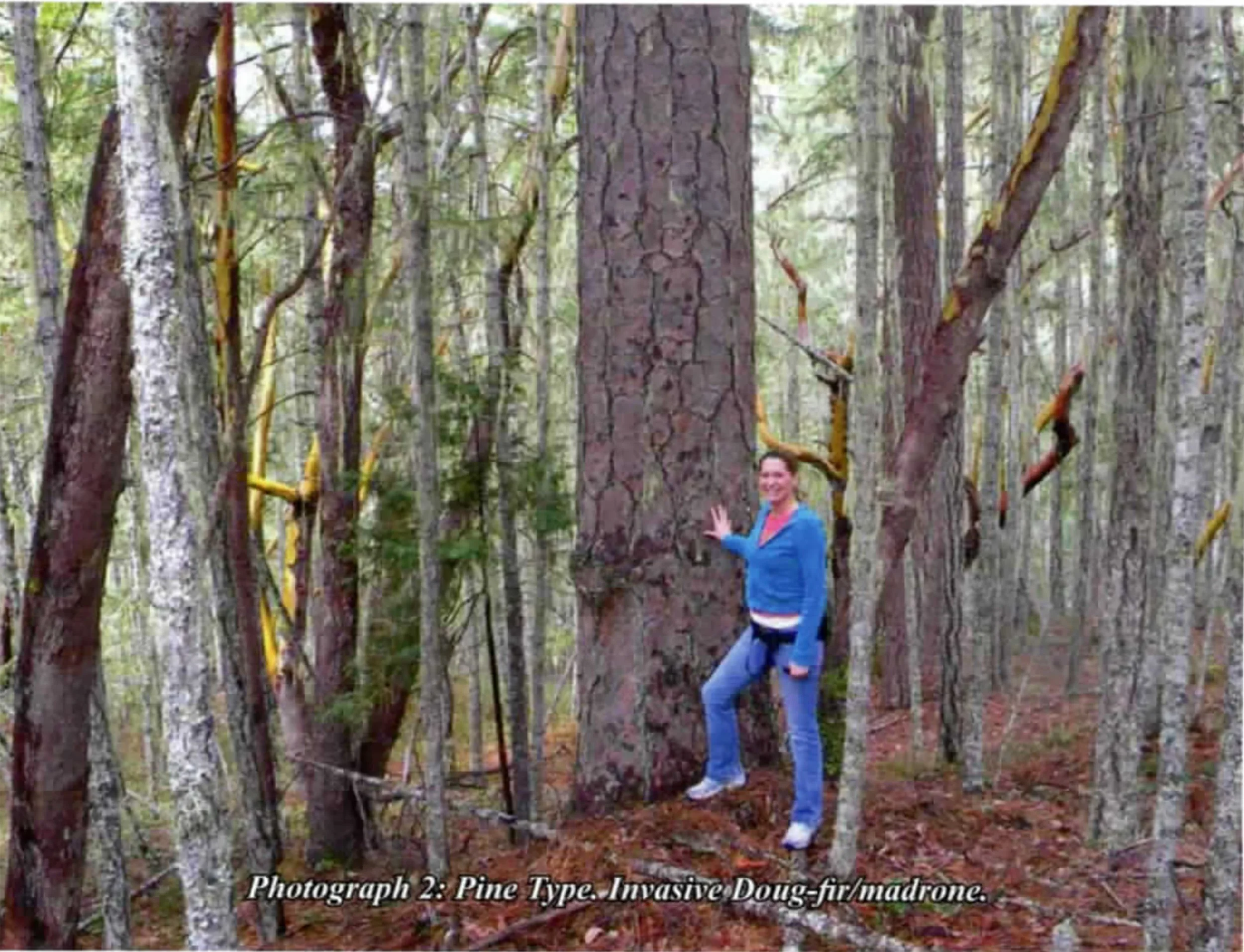
Historical research has given us the map shown: a generalized depiction of likely forest conditions in the study area during the 1800-1825 time period. The following four photographs represent typical current conditions within each of the four forest types (or “zones”) that are depicted. The large size and wide spacing of the older trees in the photographs can be gauged by the “human scale” used to measure them: Nana Lapham, long-time NW Maps Co. forest science research assistant, is 5’ 8” tall and did much of the field work on this project.
Photograph 1 shows relict trees from an oak and pine savanna that was developed and used by native residents for hundreds or thousands of years. These areas were tended by constant gathering of fuel, acorns, and pine nuts from the trees and regularly tilling and/or burning the surface area to manage understory crops, such as camas, tarweed, hazel, and beargrass. Notice how Douglas-fir have invaded the area in the past 100+ years, threatening the survival of the few remaining old-growth oak and pine.
Restoring this savanna would entail removing the Douglas-fir before they smother the remaining old-growth; removing the surface fuels that have built up around the bases of the oaks and pines; and reintroducing the types of understory plants and regular burning practices that created and maintained savanna conditions in the first place. There are thousands of acres similar to this throughout the study area, with invasive Douglas-fir slowly killing the established old-growth and creating potential crown-fire conditions by developing a continuous canopy of fine, pitchy fuels. A crown fire under these circumstances would likely kill all of the trees in this picture, including the old-growth.
Photograph 2 is a typical condition found throughout the former Pine Type in the study area. Again, these areas were maintained by regular prescribed fires in precontact time, and are now being threatened by thousands of invasive Douglas-fir and madrone.
Photograph 3 shows the 1825 Douglas-fir Type, which still contains scattered old-growth sugar and ponderosa pine; species which may have dominated this type in the Indian era. Restoration would provide the best option for prolong the lives of these historic trees, too.
Photograph 4 is a picture of Huckleberry Lake, in the high elevation True Fir Type. The “lake” is now a wetland prairie, a result of eutrophication during historical time. This area used to be a portion of a major huckleberry gathering complex, equally accessible to Indian families living in the Rogue River and South Umpqua basins due to its common ridgeline location, before these plants were shaded out by the invading conifers. In addition to the hundreds of acres of cultural plants still present in the area, numerous stone artifacts and other evidence of past use are also in widespread evidence along this ridgeline. The scattered taller trees in the background represent larger diameter, older trees likely dating to the 1600s and 1700s; the vast majority of trees, though, having established themselves after the mid-1800s and throughout the 1900s.
The common theme documented by this map and photographs is that tens of thousands of acres of old-growth oak, pine, Douglas-fir, redcedar, and other conifers exist throughout the study area in need of immediate attention, if they are to survive [Note: 17,000 acres of this study area burned in the 2013 “Whiskey Fire,” one year after this was written, costing $23 million and needing 932 firefighters to contain]. The same problem exists for the scattered patches of huckleberry, camas, tarweed, and native grasses that still persist. A forest is, ideally, composed of many facets, housing many different types and species of plants and animals. Those are the types of attributes that used to define these lands, and the same types that can be restored and maintained for future generations of people and wildlife.
Jims Creek Project: Make a Choice and Then Do It is Step 2.
The second step to forest restoration, after considering historical conditions (“options”) is to determine what future conditions are desired (goals and objectives), and to begin actively restoring and/or maintaining those prized and desired conditions across the land. An excellent example of this step is the Jims Creek forest restoration project on the Middle Fork Willamette Ranger District which, in 2012, was in the process of completing an initial 400-acre “demonstration project” portion of a 25,000-acre plan.
The Jims Creek project has demonstrated the feasibility, profitability, and general benefits of conducting landscape-scale forest restoration projects on federal forestlands, but it is also a good example of how much time and money can be spent in putting these projects together, as well as the ease and quickness with which they can be stopped by adversarial legal actions. This project was initially conceived by a local US Forest Service forester/project manager, Tim Bailey, who then spent the better portion of the next ten years shepherding his vision through the myriad public meetings, scientific reviews, committee presentations, promotional tours, and other hurdles needed to get things underway on the ground.
Picture 5 shows Bailey in front of a portion of the Jims Creek Project in 2010. This area had already been treated by removing most of the invasive conifers established during the past century, and by broadcast burning the ground so as to remove excess litter and logging debris. Note the scattered trees that have been left behind: widely spaced pine of several different age groups, from seedlings to saplings and second-growth to old-growth. Also note the small herd of elk grazing directly above Tim, near the crest of the hill.
Picture 6 is the same herd of elk as the previous picture, seen through a zoom lens. Not shown in this photograph are several more elk just over the crest of the hill and at least two blacktail deer near timberline that were photographed running deeper into the woods shortly after this picture was taken. The small charred stumps and large woody debris in the foreground will soon rot away or be consumed in the next few surface fires. The reddish-brown pattern is bracken fern, a plant harvested in large quantities by many Oregon tribes for its starchy roots and asparagus-like “fiddleheads” that grow in the spring. In a few more years, with a few more broadcast burns, this area will appear very similar to what it must have looked like hundreds of years ago -- including the regular presence of elk and deer.
Although the 400-acre Jims Creek demonstration project has clearly shown several advantages of forest restoration in this area, additional progress has been halted at this time due to an infestation of thousands of red tree voles (“tree mice”) that accompanied the migration of Douglas-fir trees into the project area during the past century. These rodents are protected against logging Douglas-firs under a federal “survey and manage” regulation, despite the fact they are not a threatened or endangered species.
This type of work stoppage, based on relatively new federal regulations and related litigation initiated by environmental organizations, has become the main difficulty in beginning and completing forest restoration projects in Oregon and throughout the West. The Jims Creek Project is also a good example of those types of problems: of the 25,000 total acres of this project within the Middle Fork Ranger District, 7,000 acres are privately owned and being managed for maximum timber production; more than 7,000 acres have been classified as spotted owl habitat; approximately 7,000 acres are in remote areas that would likely include the “taking” of spotted owls; and the remaining 4,000 acres are populated with regulated tree voles. Also, a river flows through the project area that contains two listed fish species and “there is a perception on the part of the regulatory agencies that this type of restoration work can have a negative effect on fish.”
Despite these hurdles, there is a lot of work needing to be done and a lot of people wanting to do it.
Conclusions
Forest restoration projects should be conducted on a landscape-scale basis in order to be effective biologically, aesthetically, and economically. Project boundaries should include sufficient commercial materials to treat the entire project area and to show a profit. Profitable and beneficial actions are sustainable on a long-term basis, as we have learned from more than 10,000 years of forest history in this region.
The actions needed to restore our forests to earlier, more desirable conditions would necessarily create thousands of jobs for decades -- jobs to make the best uses of our common resources, protect our old-growth and wildlife, and greatly reduce the likelihood of wildfire and the severity of such occurrences when they do take place.
Based on my own experiences and observations, I think there are four key things that must be in place for forest restoration projects to be successful on a long-term basis:
1) Areas slated for restoration should include sufficiently broad boundaries and specifications to allow projects to be profitable;
2) Restoration projects should be landscape-scale (25,000 to 250,000 acres) in size in order to be economically efficient and biologically effective over time;
3) Local residents and businesses should be in strong support of restoration projects, and be given access to all information that develops during the process;
4) Local project managers should be knowledgeable and capable of communicating scientific, technical, and political aspects of a project to local citizens.
I remain certain that the adoption of these practices, as defined, would have many immediate and positive effects on forest health, old-growth preservation, endangered species protection, rural economies, international trade balances, and many other economical, ecological, cultural, historical, aesthetic and recreational values associated with Oregon’s forests.
The degradation, destruction, and loss of our federal forests and grasslands to wildfire, bugs, and disease will continue to escalate so long as we continue our current path of passive avoidance and neglect. Restoring our Nation’s forests means restoring people – in part, as active managers – to our lands. The benefits for doing so have been listed; the impediments to getting started have been largely self-inflicted, are almost entirely political (rather than scientific or humanitarian), and can be readily surmounted, given effective leadership of common outcry. The best time for doing something is now.