Every Wildfire Hour Counts: It's Time to Put Fires Out, Not Watch Them Burn
By Frank Carroll
April 4, 2026
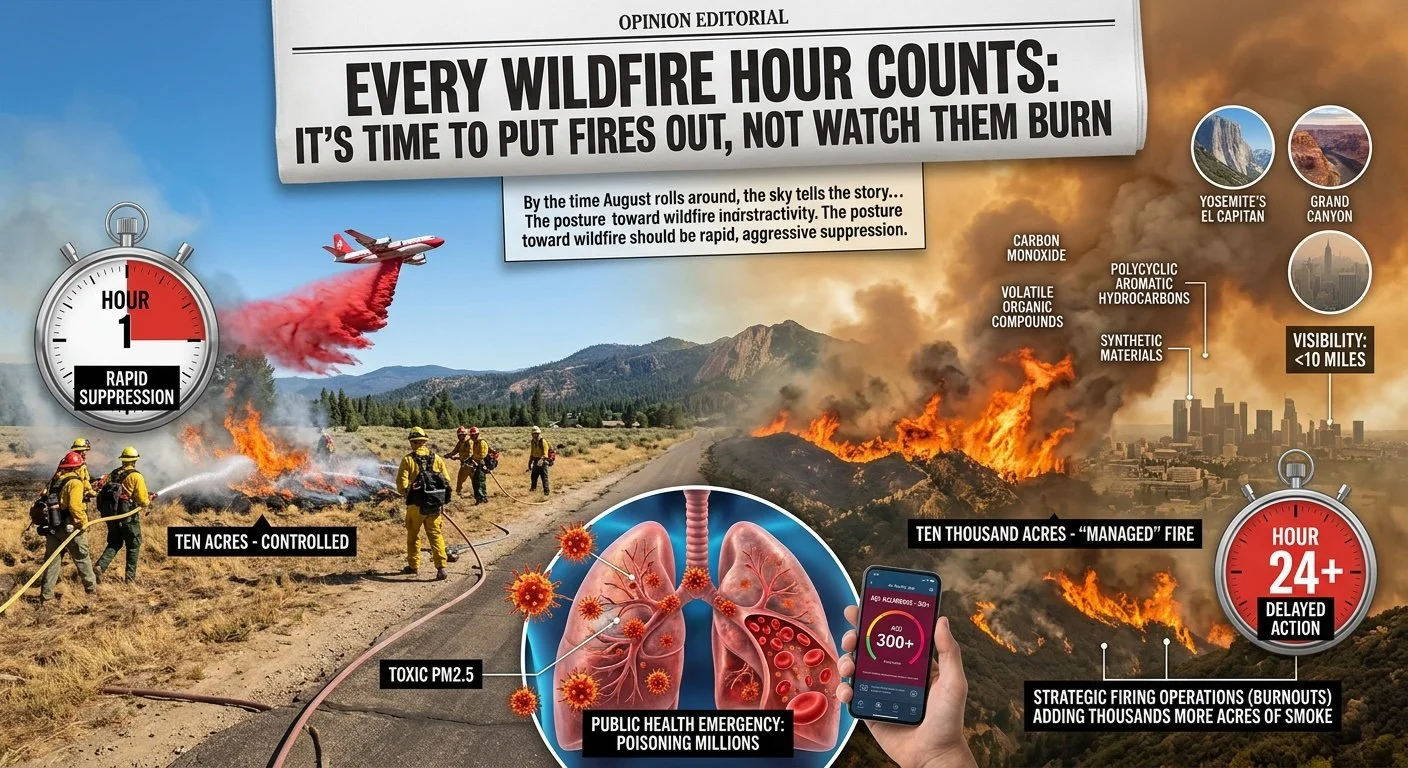
By the time August arrives in the American West, the sky tells the story. A sickly orange haze settles over cities, towns, and treasured national parks. Visibility at iconic landscapes like Yosemite, Glacier, and the Grand Canyon drops from over a hundred miles to fewer than ten. Kids stay indoors. Emergency rooms fill with wheezing patients. And somewhere, on a mountainside or in a river canyon, a fire that could have been contained at ten acres is being "managed" into ten thousand — or more.
We need to clearly state what too many in the wildfire policy establishment refuse to admit: the default approach to wildfire in the United States should be quick, aggressive suppression. Every fire that gets bigger than it needs to releases smoke that harms people. And we are hurting millions.
The health evidence is no longer in question. Fine particulate matter, known as PM2.5, is an invisible threat carried in wildfire smoke. These particles, smaller than 2.5 micrometers wide, avoid the body's natural defenses, reaching deep into the lungs and entering the bloodstream. Research published in The Lancet Planetary Health shows that wildfire-specific PM2.5 exposure is linked to a much higher risk of respiratory hospitalizations. Some studies also suggest that wildfire smoke particulates may be more toxic per unit of exposure than similar particles from other sources. The Environmental Protection Agency has pointed out that wildfire smoke not only contains fine particles but also carbon monoxide, volatile organic compounds, polycyclic aromatic hydrocarbons, and other harmful pollutants — a chemical mix produced by burning vegetation, soil, and increasingly, structures and synthetic materials inside them.
The American Lung Association has consistently warned that short-term exposure to elevated PM2.5 from wildfire smoke triggers asthma attacks, bronchitis, reduced lung function, and cardiovascular events. Longer wildfire seasons, now stretching for weeks and even months in parts of the West, worsen these immediate risks into long-term health problems. A Stanford University study found that wildfire smoke exposure across the western United States has wiped out decades of air quality improvements achieved through Clean Air Act regulations. Between 2016 and 2022, some of the worst air quality days in American history were caused not by industrial pollution but by wildfire smoke drifting into major cities like Los Angeles, San Francisco, Portland, Seattle, Denver, and Salt Lake City — places with millions of residents who have asthma, COPD, heart disease, and other conditions that make them especially vulnerable.
Yet, federal and state land management agencies still adopt strategies that worsen smoke exposure instead of fixing it. The practice of "managing" wildfires for so-called resource benefits—allowing lightning-ignited fires to burn across landscapes for weeks because fire is considered ecologically necessary—may support long-term forest health goals in some cases. But when these fires create smoke plumes that cover communities all summer, the cost is borne by people who never agreed to it: the elderly resident on supplemental oxygen in Missoula, the child with asthma in Fresno, the outdoor worker in Boise who has no choice but to breathe whatever the sky releases.
Worse still are so-called strategic firing operations, where suppression teams deliberately ignite additional fires to "box in" or "manage" a growing wildfire. While sometimes tactically necessary, these operations are too often used as a substitute for decisive early action. Burnout operations can add thousands of acres of actively burning landscape to an already dangerous situation, producing massive pulses of smoke that affect communities downwind. When a fire that started at five acres is allowed to grow to five hundred before managers decide to act, and the suppression strategy then involves intentionally burning another thousand acres, the public has a right to question whether the cure has become worse than the disease.
None of this is to say that every wildfire can be stopped in its tracks. Terrain, weather, drought conditions, and resource limitations guarantee that some fires will escape initial attack and grow into campaign-level events. That is an unavoidable reality of living in fire-prone landscapes. But acknowledging that reality is very different from institutionalizing passivity. The goal should be clear and unwavering: contain fires as quickly as possible, at the smallest size possible, with the resources necessary to do so. Fires that escape despite best efforts will still produce smoke. But fires that escape because agencies chose to wait or opted to "monitor" rather than mobilize represent a failure of public health obligation.
Our national parks deserve skies that visitors can see through. Our cities deserve summers that don't require residents to seal their windows and check air quality apps before stepping outside. And the most vulnerable among us — children, the elderly, those with chronic respiratory and cardiovascular conditions — deserve a policy framework that treats the smoke pouring into their lungs as the public health emergency it is.
Put the fires out. Put them out early. Put them out small. Lives depend on it.