Burn Back Better? USFS Chief's Letter of Intent ProvokesRevolt in the Firefighting Community
By Dana Tibbitts
May 4, 2024
Source: https://thenevadaglobe.com
Publication.pdf
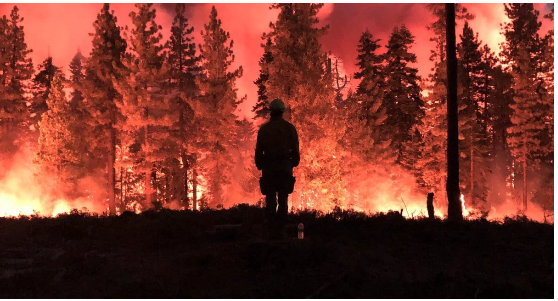
Night operations on the Caldor Fire in September, 2021. An engine crew member monitored the control line of a back burn conducted by Deschutes Engine 636. Photo by Acacia England, U.S. Forest Service (Photo:National Interagency Fire Center) 28 May 2024 8:52 pm
“The Forest Service has no authority to let fires burn millions of acres— misappropriating tax dollars and recklessly destroying our natural resources…It’s an inverse condemnation of private property and wanton destruction of public resources, pure and simple,” Chief forester Frank Carroll
The United States Forest Service (USFS) just gave firefighters license to burn millions of acres of forest and rangelands with zero commitment to putting the fires out. Randy Moore, Chief of the nation’s largest fire agency, announced he will continue the fire policy that has incinerated nearly 30 million acres of public and private lands over the last five years.
Moore’s recent Letter of Intent (LOI) (see below) to his troops predicts “a very active fire season.” The letter blurs fire policy, jurisdictional boundaries, and any strategic framework for fighting fire by lighting more fire. Indeed, the Chief’s “Burn Back Better” letter has caused a firestorm among firefighters and Forest Service veterans nationwide.
“We ain’t seen nothing yet,” said one fire veteran in response to the letter. “The USFS is doubling down. The Chief’s claim of a ‘historic achievement of 4.3 million acres of restoration’ prioritizes rampant ‘Wildfire Use’ over a strong ‘Initial Attack’ to put the fire out from the get-go. It’s also a misappropriation of congressionally appropriated funds allocated to the agency for emergency fire suppression.”
“Last year was a reprieve,” National Wildfire Institute (NWI) sources say. “Forest maintenance is down, so acres burned will likely increase. It’s only May 22, and about two million acres have already burned. Look for about eight million acres to burn in the 2024 fire 2/8season as a strong ‘Initial Attack’ policy gives way to a ‘managed’ or ‘beneficial’ fire. If history is a guide, the West will bear the brunt.”
Cynically, the USFS’s new “full fire suppression” definition includes letting fires burn for reasons including “restoration” strategies that rely on so-called “managed” or “beneficial” wildfires that burn much longer and hotter than necessary, and at great expense to American homeowners and their insurers.
The colossal fiascoes of the Caldor, Tamarack, and Dixie fires of 2021 are case in point. These fires were allowed to run for months, consuming almost 1.3 million acres of Sierra Nevada forest. The costs of Caldor Fire damages alone ran in the billions of dollars, not including trees and wildlife lost, or damages to 1,200 residents displaced from their homes.
Burning an average of more than six million acres a year over the last decade is now a standing order for the USFS, not only in California but across the nation. The wholesale use of “managed” or “prescribed” fire under the guise of firefighter safety, forest health, and resilience and restoration, is scarring landscapes, devastating forests, and leaving vast lifeless ecosystems with few signs of recovery.
The Forest Service is just warming up. With 2022 federal fire plans calling for another 60 million acres to burn over ten years, operation Burn Back Better—AKA Operation Scorched Earth—is well underway.
Tahoe-Douglas Fire Chief and head of the Northern Nevada Fire Chiefs Association, Scott Lindgren said, “The latest forecast and guidance from the Chief is so unhinged from firefighting realities on the ground as to defy rational analysis or practical guidance.”
USFS Regional Foresters are deploying a new policy, calling for all fires in the Tahoe Basin to be risk-assessed and monitored by USFS Regional Foresters, who alone would determine the appropriate response to new fire ignitions.
Lindgren rejects the idea. “It’s a non-starter. If a fire in the Basin threatens my jurisdiction or community, we’re not going to wait around. We’ll hit every fire hard and direct with everything we’ve got. Managed fire is not an option. Look at Caldor and Tamarack. We need to put fires out immediately.”
“The USFS decision to allow these fires to burn is criminal,” Lindgren added. “I’m very disturbed that, by allowing these fires to burn like they did in the Tamarack Fire, they get to count those acres as ‘treated.’ These are not treated acres—they are destroyed acres!”
Rapidly suppressing wildfires is not on the lexicon of USFS response options, a problem that cost the town of Grizzly Flats dearly in the throes of the early Caldor fire. Fire bosses called off six fire engines for the night in deference to “firefighter safety.”
Wildfire Pro’s chief forester Frank Carroll says USFS fire commanders and administrators are using firefighter safety as a false flag to justify wildfire use, even at the expense of civilian lives and devastated communities.
“Firefighter safety is an excuse that is neither safe nor supportable—a feature of the persistent failure to build informed consent and to analyze environmental impacts before letting wildfires burn and then expand them on purpose,” Carroll said. “They’re unilaterally implementing giant prescribed wildfires—consequences be damned. Sixteen civilians died in a 2020 fire that raced to 194,000 acres one afternoon following days of “widespread firing operations.”
Indeed, Chief Moore’s letter prioritizes workforce safety ahead of strong suppression and public safety. “Safety is one of our core values” along with “continued emphasis on employee wellbeing,” he writes. However, putting “USFS people first and managing employee mental and physical fatigue” won’t put out wildfires or protect forests, rangelands and personal property.
Many in the fire community are alarmed by the absence of direction from the USFS Chief to actually put out wildfires. Despite strong recommendations from fire insiders like National Wildfire Institute to bolster the science, sustainability and success of USFS fire policy none of their recommendations was adopted in the final LOI.
“What happened to, First put out the fire!” asked one dismayed former USFS executive, Michael Rains. “How hard would it be to include this in the LOI—Strive to put out every unplanned wildfire within 24 hours of detection. What an opportunity lost!”
5/8“The Chief’s policy on allowing ‘managed wildfires’ is outrageous, ill-conceived, and probably illegal,” Carroll said. “The policy denies due process to private property owners with no say in decisions that inevitably burn their private property. The Forest Service has no authority to let fires burn millions of acres—misappropriating tax dollars and recklessly destroying our natural resources.”
When Fire Chief Lindgren testified before the House Committee on Natural Resources in 2022, he raised concerns about Chief Moore’s LOI continuing to advocate the catastrophic burn policy, even after the Caldor and Tamarack fire debacles.
“Many local fire chiefs were very upset,” Lindgren testified. “So, we wrote our own letter of intent, which we believe reflects the public’s expectations and demands of us.” Over 30 chiefs in California and Nevada sign the letter annually.
“We will aggressively attack all fires within or threatening our jurisdictions. We will hit them as fast and hard as possible when they are small. In these unprecedented conditions, we can’t afford the risk to our public, our communities, the environment, the wildlife, critical infrastructure, or our firefighters by letting these fires grow out of control. We will use every available resource and tool to keep this from happening…We will find a way to get ahead of it and stop it at all costs,” Lindgren stated.
“Why can’t the USFS take a similar stance?” Lindgren asked. “Burn Back Better isn’t working.”
The Biden-Harris administration’s plan to Burn Back Better, detailed in Confronting the Wildfire Crisis, lays out a 10-year plan to treat (code for burn) 20 million acres of National Forest System lands, 30 million acres of other Federal, State, Tribal, and private lands, and an additional 10-million-acre targeted burn. That’s a whopping 60 million acres of unauthorized, ill-conceived, unilateral burn treatments for America’s forests, rangelands, and Wildland Urban Interface communities—all in the name of so-called science, resilience and restoration.
“It’s an inverse condemnation of private property and wanton destruction of public resources, pure and simple,” Carroll said. “It must be stopped.”